

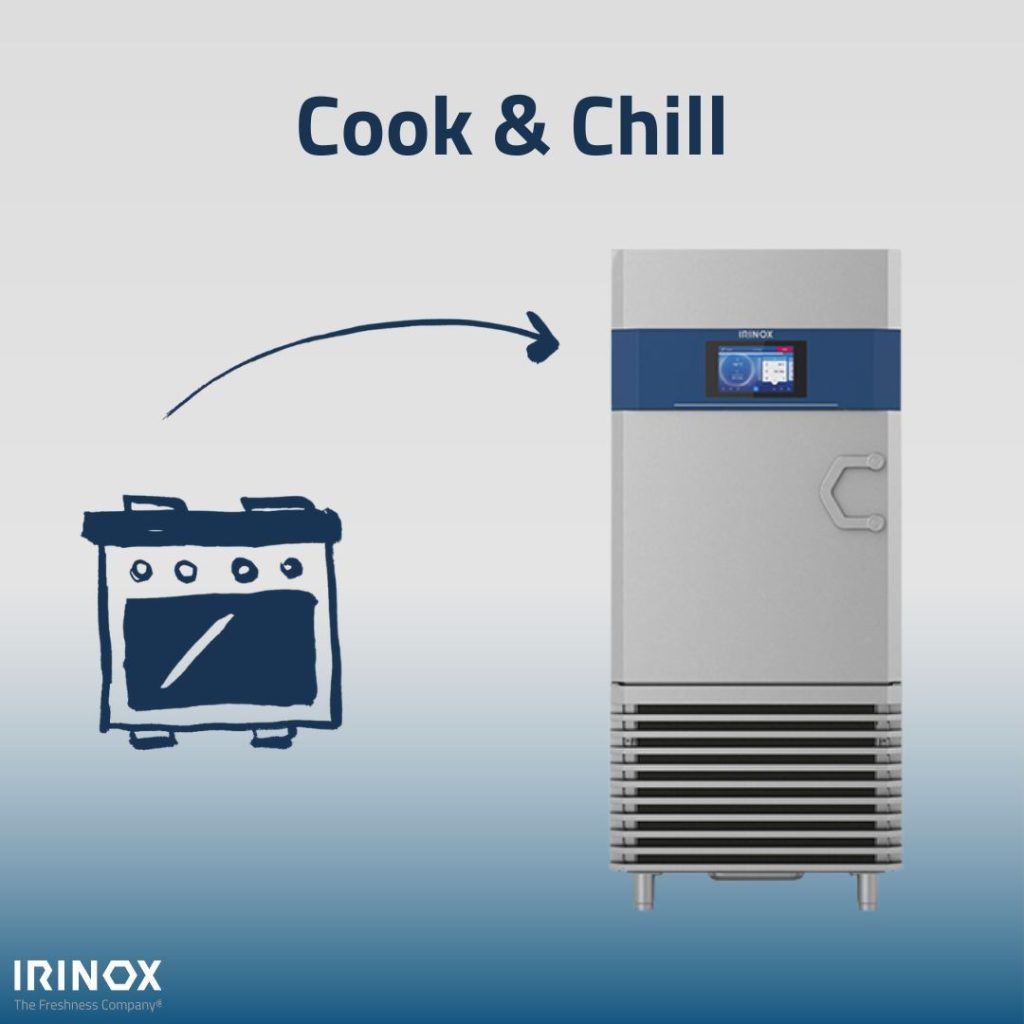
There is a method behind the consistency of the world’s best professional kitchens. Whether it is a Michelin-starred restaurant serving 80 covers a night, a hotel feeding 400 delegates at a conference, or a bakery producing hundreds of units before dawn — the common thread is rarely talent alone. It is process. Specifically, it is Cook and Chill.
Cook and Chill has become the operational backbone of high-performing food businesses worldwide. Here is what it is, how it works, and why IRINOX technology makes it more effective than any other system on the market.
What is Cook and Chill?
Cook and Chill is a food production method in which food is fully cooked and then immediately blast chilled to a safe storage temperature before being regenerated and served at a later time.
The process has two essential steps:
1. Cook — food is prepared and cooked to the required core temperature using conventional cooking methods.
2. Chill — immediately after cooking, while still hot, the food is placed in a blast chiller. The blast chiller rapidly brings the core temperature of the food from cooking temperature down to +3°C — passing through the bacterial danger zone (+8°C to +68°C) as quickly as possible.
Once safely chilled, the food can be stored in a holding cabinet for up to five days without any loss of quality, flavour, or safety. When needed, it is regenerated — brought back up to serving temperature — and served.
Why does speed matter so much in the chilling step?
The science behind Cook and Chill is straightforward. Bacteria multiply most rapidly between +8°C and +68°C. The longer food spends in this temperature range, the greater the bacterial load — and the shorter and less safe its shelf life becomes.
Conventional cooling methods — leaving food to cool at room temperature, or placing it directly in a standard refrigerator — are dangerously slow. A large batch of cooked food can take hours to reach a safe temperature through conventional means, during which time bacterial proliferation is continuous.
A blast chiller eliminates this problem entirely. The IRINOX MultiFresh® brings the core of any food — even boiling hot, straight from the oven or pan — down to +3°C rapidly and consistently, regardless of portion size or product type. The danger zone is crossed in minutes, not hours. Bacterial growth is halted before it has the chance to develop.
What are the operational benefits of Cook and Chill?
Separation of production from service
This is the transformational benefit that most kitchens discover first. With Cook and Chill, the production of food no longer needs to happen at the same time as service. Large batches can be cooked during quieter periods — overnight, early morning, or between services — blast chilled immediately, and held ready for regeneration during the busy service period.
The result is a kitchen that runs with far less pressure, far more consistency, and far greater efficiency. Fewer staff are needed at peak times. The quality of every dish is controlled during production rather than improvised under pressure during service.
Menu flexibility and demand management
Cook and Chill allows kitchens to produce in response to planned demand rather than reactive demand. A restaurant can prepare large quantities of its most popular dishes in advance, held safely in cold storage, and regenerate precisely the number needed based on actual bookings. Nothing is wasted. Nothing runs out.
For catering operations managing events of varying sizes, this is particularly valuable. A catering company using Cook and Chill can prepare all food days in advance, transport it safely chilled, and regenerate on site — without any compromise on quality.
Reduction of food waste
One of the most significant costs in any food business is waste — ingredients that spoil before use, prepared dishes that do not sell, over-production that cannot be stored safely. Cook and Chill addresses all three.
Ingredients can be purchased in bulk at the best price, processed at their peak quality, and blast chilled for use over days or weeks. Prepared dishes that would otherwise be discarded at the end of service can be safely stored and served the following day. Production can be planned precisely against confirmed demand, eliminating the guesswork that leads to over-production.
Consistent quality at every cover
Perhaps the most underappreciated benefit of Cook and Chill is what it does for consistency. In a conventional kitchen, the quality of a dish depends on which chef prepared it, how tired the team is, how busy the service is. In a Cook and Chill kitchen, every dish is produced under controlled conditions, blast chilled at the correct moment, and regenerated to the correct temperature. The result is identical quality at every cover, regardless of circumstances.
How does regeneration work?
Regeneration is the process of bringing blast chilled or shock frozen food back up to serving temperature. Done correctly, regenerated food is indistinguishable from food served fresh — and in some cases, particularly with braised meats and slow-cooked dishes, it is actually superior, as the resting period during cold storage allows flavours to develop further.
The IRINOX MultiFresh® includes a dedicated regeneration cycle that brings food from +3°C or -18°C back to serving temperature precisely, preserving moisture and preventing oxidation. The serving time can be programmed in advance so that food arrives at the correct temperature exactly when it is needed — without any manual monitoring.
Cook and Chill versus Cook and Freeze
Cook and Chill is not the same as Cook and Freeze, though both methods use blast chilling technology. The key differences are:
Cook and Chill brings food to +3°C and stores it refrigerated for up to five days. It is best suited to high-turnover operations where food will be used within that window.
Cook and Freeze brings food to -18°C via shock freezing and stores it frozen for weeks or months. It is best suited to operations that need to manage longer production cycles or larger inventory buffers.
The IRINOX MultiFresh® handles both in a single unit. The same machine that blast chills today’s service preparation can shock freeze tomorrow’s inventory — with a single button press and without any compromise on food quality.
The role of holding cabinets in a Cook and Chill system
A blast chiller is only half of a Cook and Chill system. Once food has been brought to the correct temperature, it needs to be stored at that temperature — precisely, consistently, and for as long as required.
This is where the IRINOX CP Next and CK Next holding cabinets complete the cold chain. Designed specifically to work alongside IRINOX blast chillers, they maintain precise positive temperatures from -5°C to +15°C with gentle, uniform ventilation across every shelf. Temperature recovery after door openings is near-instant, ensuring that storage conditions remain stable even in a busy kitchen environment.
Together — blast chiller and holding cabinet — they form a complete Cook and Chill infrastructure that gives any professional kitchen full control over its production from cooking through to service.
Which IRINOX equipment is right for a Cook and Chill operation?
The right equipment depends on the volume and type of operation:
For restaurants, hotels, and professional kitchens — the IRINOX MultiFresh® Next range offers the complete Cook and Chill toolkit in a tray-loaded unit available in six sizes. Blast chilling, shock freezing, regeneration, low-temperature cooking, and holding are all handled in a single machine.
For high-volume catering, large hotel kitchens, and food production — the IRINOX MultiFresh® MyA roll-in range scales from single to four-trolley configurations, allowing entire batches to be processed in a single cycle. Remote monitoring via FreshCloud® ensures full HACCP compliance with no manual record-keeping.
For cold storage — the IRINOX CP Next and CK Next holding cabinets provide the precision storage that completes every Cook and Chill system, with up to 40% energy savings compared to previous generation equipment.